The AFN Network+ has become Root and Reason, the food resilience collective. Visit rootandreason.org.uk for new insights, events and more.


Net zero transitioning: redefining assumptions behind access to low-carbon food in resource-constrained communities
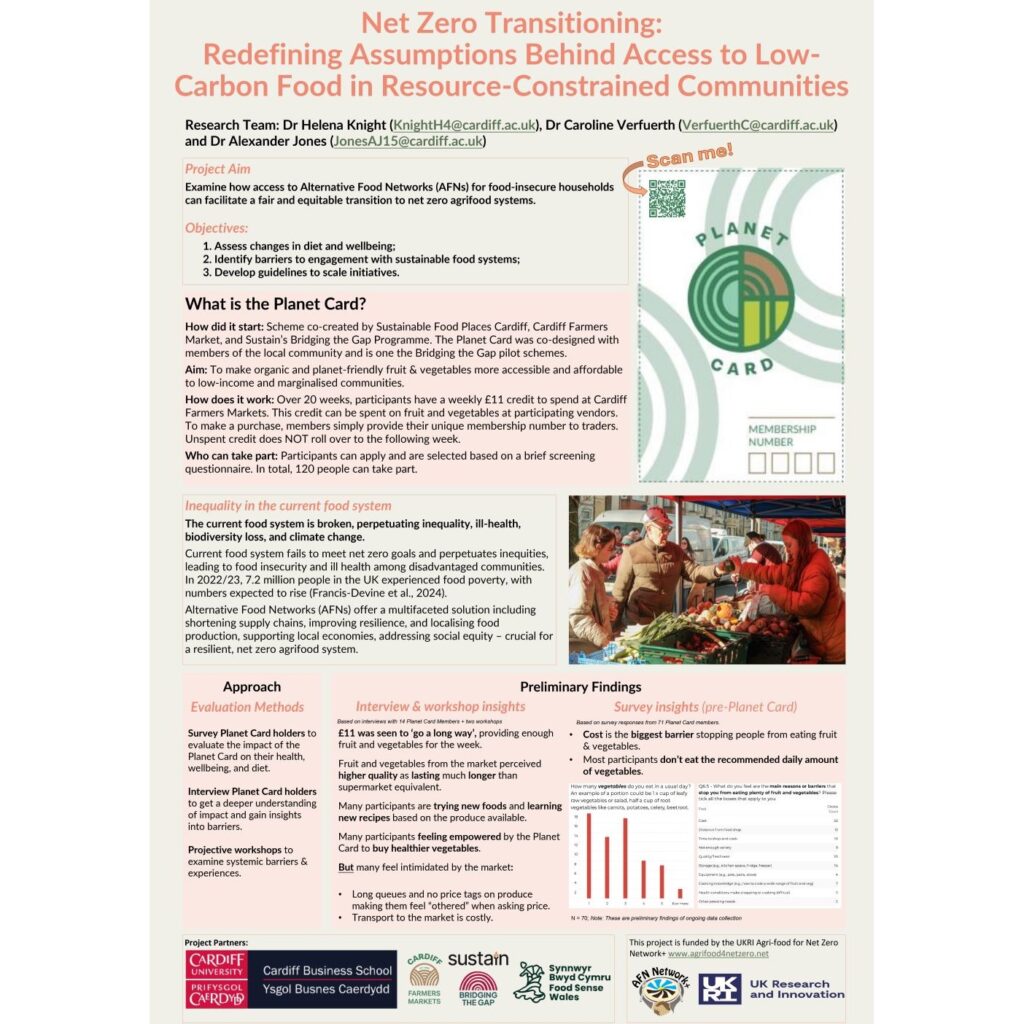
This project explores how local alternative food networks such as farmers markets, can help people facing food insecurity while also promoting a fair transition to net zero. Partnering with the Planet Card initiative, which subsidises organic food to 120 food-insecure households in Cardiff, the project will assess the impact on diet, wellbeing, and the community. The project will examine changes in wellbeing, identify barriers to engaging with sustainable food systems and develop guidelines for similar initiatives in the future.
Project lead: Helena Knight (Cardiff University Business School)
Project co-lead: Caroline Verfuerth (Cardiff University Business School and CAST)
Project collaborators: Hannah Gibbs (Bridging the Gap & Sustain: the alliance for better food and farming), Pearl Costello (Sustainable Food Places Cardiff & Food Sense Wales), Carol Adams (Cardiff Farmers Market), Jingli Wang (Cardiff University Business School), Alexander Jones (Cardiff University Business School), Mark Wilson (University of Bath and CAST)
This project explores how local alternative food networks such as farmers markets, can help people facing food insecurity while also promoting a fair transition to net zero. Partnering with the Planet Card initiative, which subsidises organic food to 120 food-insecure households in Cardiff, the project will assess the impact on diet, wellbeing, and the community. The project will examine changes in wellbeing, identify barriers to engaging with sustainable food systems and develop guidelines for similar initiatives in the future.
Project lead: Helena Knight (Cardiff University Business School)
Project co-lead: Caroline Verfuerth (Cardiff University Business School and CAST)
Project collaborators: Hannah Gibbs (Bridging the Gap & Sustain: the alliance for better food and farming), Pearl Costello (Sustainable Food Places Cardiff & Food Sense Wales), Carol Adams (Cardiff Farmers Market), Jingli Wang (Cardiff University Business School), Alexander Jones (Cardiff University Business School), Mark Wilson (University of Bath and CAST)

Findings
- Affordability is a central factor in scaling potential as confirmed in strong demand for locally grown organic produce when affordability barriers are removed.
- Behavioural empowerment: Enabling access for low income households to locally produced organic fruit and vegetables by removing financial barriers can lead to improvements in emotional wellbeing and a stronger sense of control and confidence over food choices and cooking while also improving household stability and reducing financial stress.
- Overall wellbeing and community cohesion: developing schemes that ensure regular engagement by participants can facilitate new social relationships and community routines.
- Accessibility convenience: Future scaling of initiatives similar to the Planet Card is likely to require the focus on removing barriers related to location and frequency of retail outlets selling locally grown organic produce, such as integration of produce into small local retail outlets, and expanded market frequency (Cardiff farmers markets are only on Saturdays and Sundays when families may be busy with other family-related activities).
Suggestions for further research
We identified a notion that the importance of a direct relationship between the farmer and the participants may play a significant role in enhancing learning regarding small scale and organic farming. Directing focus to this area in future research may help validate the notion and develop further insights.
Poster Presented at the AFN Big Tent 2025