The AFN Network+ has become Root and Reason, the food resilience collective. Visit rootandreason.org.uk for new insights, events and more.


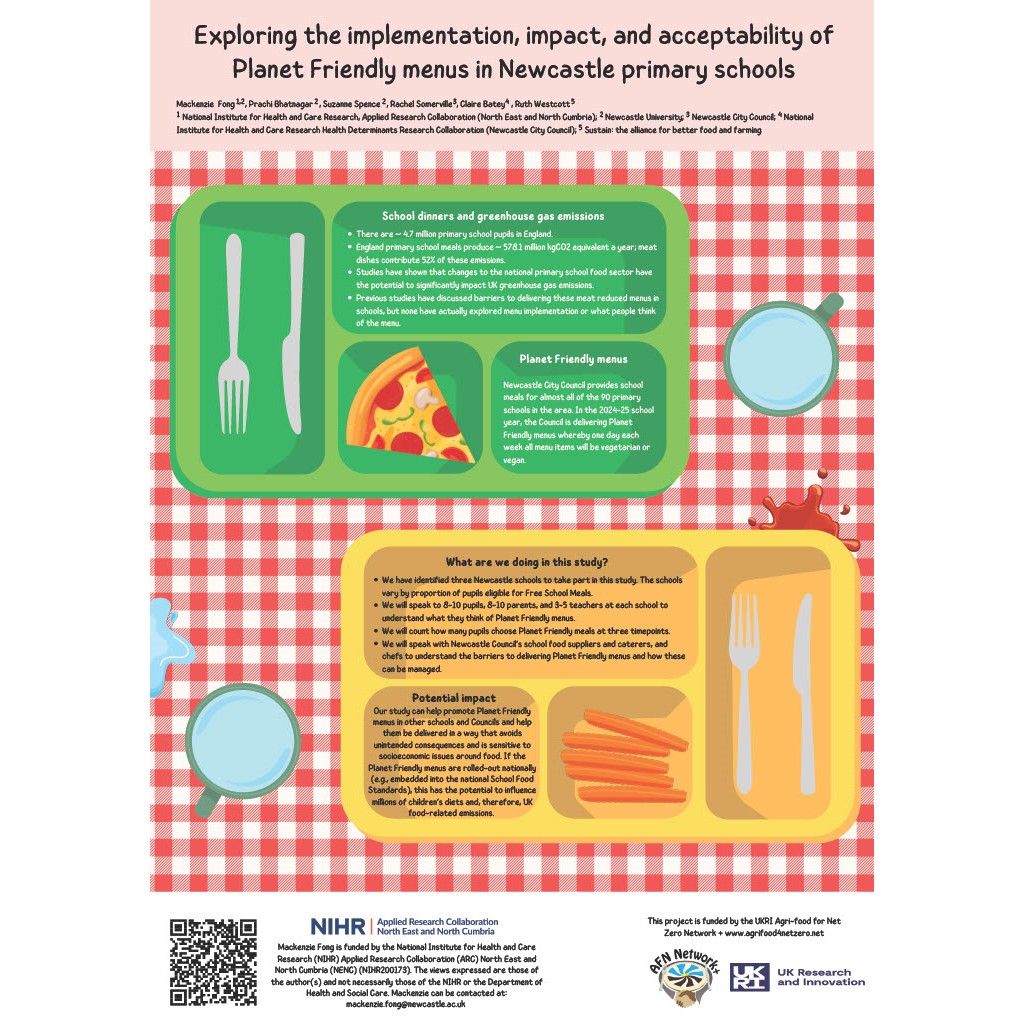
Exploring the implementation, impact, and acceptability of ‘planet friendly’ menus in Newcastle primary schools
Newcastle primary schools will introduce vegan/vegetarian low emission menus one day a week starting in the 2024-25 school year. This project aims to prepare for a future study by exploring the delivery and impact of these menus. The team will consult with school food suppliers, caterers, head teachers, and chefs at three schools to identify barriers and potential solutions to delivering the low emissions menus. They will also gather input from pupils, parents, and teachers to understand their views on the menus and how they influence eating habits. These insights will inform the design of a larger study in more schools.
Project lead: Mackenzie Fong (Newcastle University)
Project collaborators: Rachel Sommerville (Net Zero Team, Newcastle City Council), Claire Batey (Newcastle Health Determinants Research Collaboration, Newcastle City Council), Ruth Westcott (Sustain: the alliance for better food and farming), Prachi Bhatnagar (Newcastle University), Suzanne Spence (Newcastle University)
Findings
- Parents and pupils were unaware of the Planet Friendly initiative. In contrast, when similar initiatives were previously labelled “Meat Free,” schools experienced significant parental backlash. A low-profile, “stealth” approach is recommended, avoiding labels such as “meat-free,” or “vegetarian,”.
- In principle, parents, staff, and pupils supported Planet-Friendly menus and saw them as a positive step toward addressing climate change. However, they felt the initiative would only be meaningful if embedded within a whole-school approach, including education, and implemented nationally.
- Parent and staff raised concerns about meal quality and nutritional adequacy, alongside a strong dislike of “fake meat”, which were viewed as inconsistent with health and sustainability goals.
- Catering staff highlighted structural and financial barriers, including limited refrigerated storage and higher labour and delivery costs, which restricted the use of fresh, whole foods.
- Planet-Friendly meals are better received when they are introduced through familiar foods e.g., vegetarian curries, rather than unfamiliar dishes
Suggestions for further research
Future research should focus on:
- What support can be provided to Local Authorities and school food catering staff to support implementation of healthy, sustainable food menus that focus on wholefoods
- What is the environmental impact (incorporating food waste) and nutritional composition of Planet Friendly days and other menu designs that aim to enhance sustainability e.g., reduction in portions of ruminant meat
- Co-creation and evaluation of whole school approaches (including educational elements) to enhance sustainability of the school food environment
Poster Presented at the AFN Big Tent 2025